Most companies today use AI as a tool.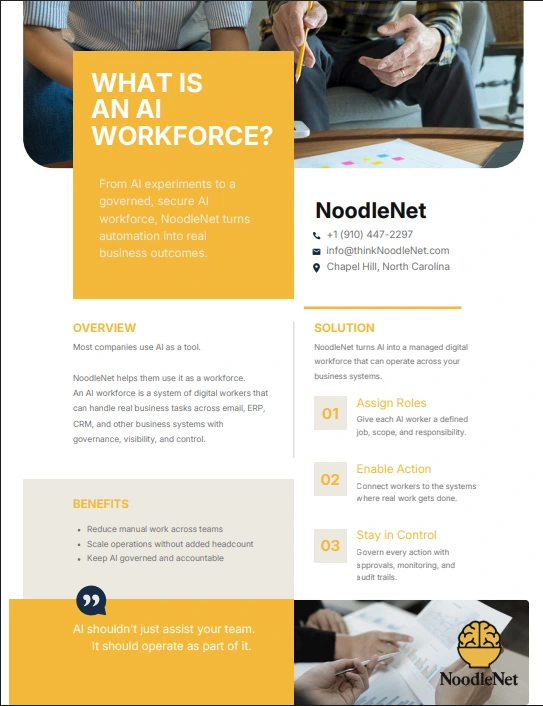
It writes emails. Answers questions. Generates content.
It helps—but it doesn’t own anything.
And that’s the problem.
Because the next phase of AI isn’t about better tools.
It’s about something fundamentally different:
An AI workforce.
From Tools to Workers
We’ve spent the last few years experimenting with AI.
Teams are testing prompts. Automating small tasks. Exploring what’s possible.
But most of these efforts stay disconnected.
They don’t scale. They don’t integrate deeply. And they don’t operate inside real business workflows.
An AI workforce changes that.
Instead of using AI as a helper, companies begin using AI as a system of digital workers—agents that perform actual business functions across their tools.
Not just generating content.
Actually doing the work.
What Is an AI Workforce?
An AI workforce is made up of digital workers—AI agents that can perform real business tasks across systems like:
ERP (like Odoo)
CRM platforms
Email and communication tools
Internal workflows and operations
These workers can:
Process incoming emails
Update records in your systems
Follow up with customers or leads
Support finance, sales, and operations teams
Execute repeatable workflows with speed and consistency
They don’t replace your team.
They extend it.
The Real Challenge: Control
Here’s where most companies get stuck.
It’s not that AI can’t do the work.
It’s that most AI tools aren’t designed to operate inside real business environments.
They lack:
Governance
Permissions
Approval workflows
Auditability
So companies end up with powerful tools… that they can’t fully trust.
And without trust, there’s no scale.
From Experimentation to Operations
To move forward, businesses need to shift from:
👉 AI as experimentation
to
👉 AI as operations
That means:
Defining clear roles for AI workers
Connecting them to real systems
Controlling how and when they act
Monitoring everything they do
In other words—managing AI the same way you manage people and processes.
Where NoodleNet Fits
NoodleNet enables companies to build and manage a governed, secure AI workforce.
Instead of disconnected tools, you get a system where AI workers:
Have defined roles and responsibilities
Are connected to your business systems
Operate with approvals and permissions
Are fully visible and auditable
This turns AI from something you experiment with…
into something you can actually run your business on.
The Shift Is Already Happening
We’ve seen this pattern before.
Spreadsheets became systems.
Scripts became platforms.
Automation became infrastructure.
Now AI is following the same path.
The companies that win won’t be the ones using AI the most.
They’ll be the ones who structure it, govern it, and scale it.
Final Thought
AI isn’t just something you use anymore.
It’s something you manage.
And the businesses that understand that early
will have a massive advantage.
