Let’s be honest: The NoodleNet Gateway is not the sexy side of AI.
It is not the shiny demo.
It is not the witty chatbot moment.
It is not the flashy “look what the agent just did” screenshot.
But it might be one of the most important parts of the entire NoodleNet ecosystem.
The job nobody brags about
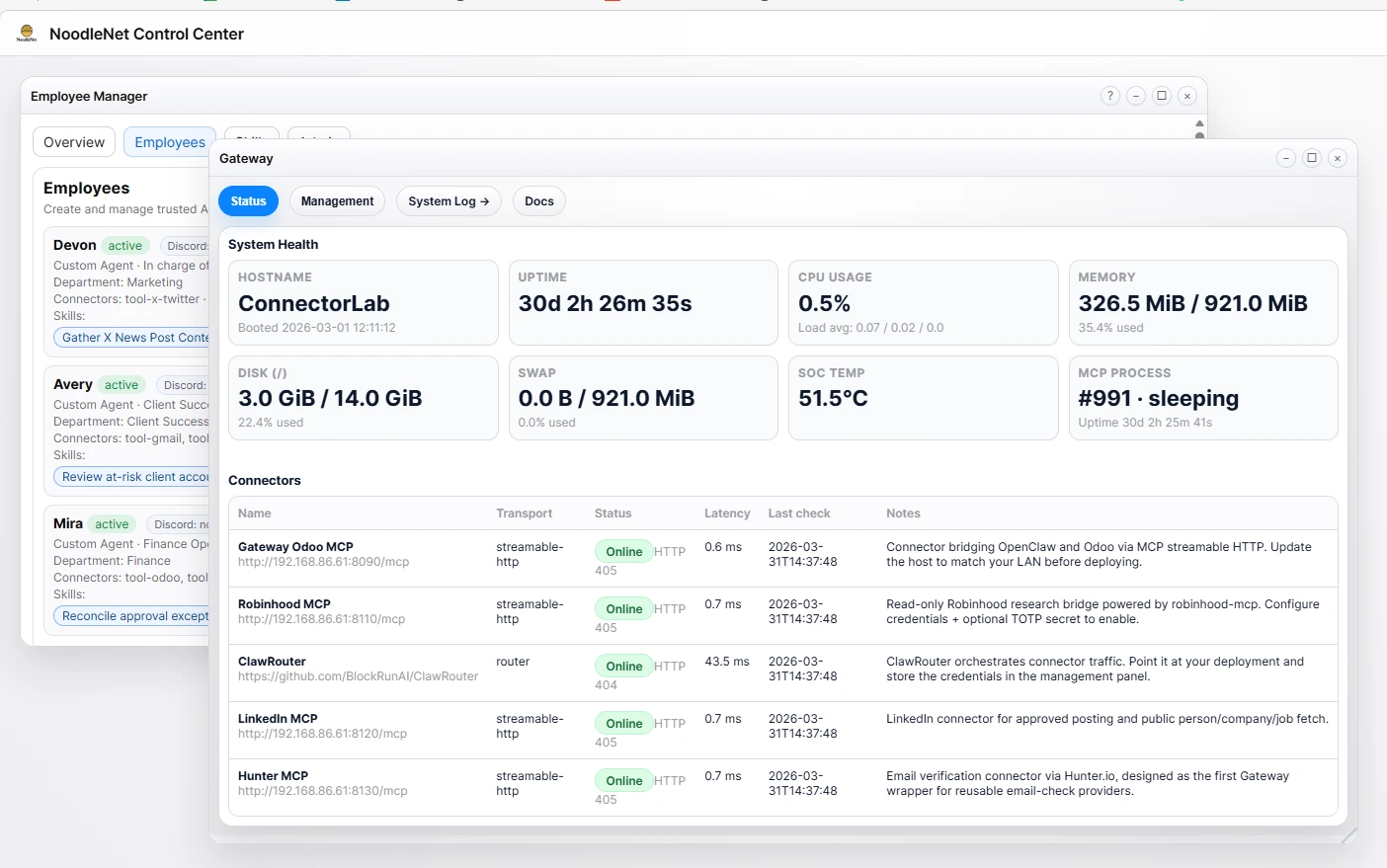 NoodleNet Gateway is the connector and control layer of NoodleNet. It is where APIs, MCP servers, external tools, and business systems come together into one manageable surface.
That may not sound glamorous, but in practice it solves one of the biggest real-world problems in AI systems: connections break, integrations drift, and one-off setups become chaos.
Without a control layer, every agent or workflow ends up with its own fragile direct connection to the systems it needs. That creates duplication, inconsistent behavior, and endless troubleshooting. It also makes scaling harder, because each new use case adds more spaghetti instead of more structure.
Gateway changes that.
Instead of treating integrations like scattered hacks, it turns them into shared infrastructure. Connections can be managed once, configured once, validated once, and then reused cleanly across the broader NoodleNet environment.
That is the technical reason it matters. But for me, the reason is even simpler.
The stable Odoo connection changed everything
The most important thing NoodleNet Gateway has given me so far is a stable Odoo connection.
That may sound small until you have lived the alternative.
When you are trying to build AI systems that actually interact with business platforms, instability kills momentum. A flaky connection turns every workflow into an experiment. Every test becomes suspect. Every demo feels risky. You stop focusing on what the AI should be doing for the business and start worrying about whether the pipe is going to hold together.
Gateway solved that problem for me in a meaningful way.
It gave me a dependable layer between NoodleNet and Odoo. That stability matters because Odoo is not just another app in the stack. It is a business system of record. If you want AI to move beyond novelty and into real operational usefulness, you need trustworthy connectivity to the platforms where the business actually runs.
A stable Odoo connection is not just a technical win. It is the difference between “interesting prototype” and “usable system.”
The unsexy business case is actually the serious business case
There is another side of Gateway that matters just as much, and this is where things get even less sexy.
Gateway can log model usage and skills usage.
Again, not a flashy demo feature. No one is putting “look at this beautiful audit trail” on a conference keynote slide.
But in the real world, this is the kind of thing businesses care about once AI moves past experimentation.
Who used which model?
What skill was called?
What connector touched which business system?
How often is it being used?
Where is cost accumulating?
Where is risk accumulating?
What is actually delivering value?
These are not side questions. These become core governance questions the moment AI starts touching real workflows.
And this is where Gateway starts pointing toward a much bigger message: the Office of the CFO.
AI needs an operational and financial story
A lot of AI conversation still lives in the land of possibility. Smarter prompts. Better assistants. Faster automation. More content. More output.
All of that matters.
But eventually, someone in the business is going to ask the practical questions:
What is this costing us?
What are people actually using?
Which tools are providing value?
Can we govern it?
Can we trust it?
Can we scale it without losing control?
That is where Gateway becomes more than an integration layer. It becomes part of the operational and financial story of AI adoption.
If Gateway is logging model usage and skills usage, then it is helping create the visibility needed for real business oversight. That does not just help IT. It does not just help developers. It helps build the language that finance leaders, operations leaders, and executives need in order to take AI seriously.
In other words: Gateway helps move AI from “cool” to “controllable.”
And controllable is what gets funded.
Why this matters beyond NoodleNet
This is not just a NoodleNet issue. The broader AI ecosystem is heading into a messy phase, especially around tools, integrations, and MCP servers.
Everyone is wiring together agents, tools, APIs, and connectors as fast as they can. That is exciting, but it is also creating a growing management problem. The stack gets harder to understand. Connections multiply. Configurations drift. Trust starts to erode.
That is why Gateway matters beyond my own build.
It offers a single place to organize, monitor, configure, and expose MCP connections and external tools in a way that is reusable and manageable. Instead of every new AI workflow creating another brittle custom setup, Gateway creates a cleaner shared surface.
That matters for scale.
It matters for maintainability.
And it matters for trust.
The future of AI is not just intelligence. It is controlled intelligence.
I keep coming back to this point: the future of AI in business is not just about what the model can say or generate. It is about whether the system around it is dependable enough to operate inside real business environments.
That means governance.
That means observability.
That means stable integrations.
That means reusable connectors.
That means knowing what happened, when, and why.
It also means accepting that some of the most important parts of an AI platform are the parts that do not look exciting in a demo.
Gateway is one of those parts.
It is the plumbing.
It is the control layer.
It is the place where trust starts to become possible.
And yes, it is not the sexy side.
But in business systems, the unsexy side is often the side that wins.
