A consultant can demonstrate a useful helper using example business records without proving that it is integrated with Odoo.
That distinction matters when a prototype is convincing. A result may be correct for the sample while the real questions—supported versions, field meanings, account access and write behavior—remain unanswered.
Start by naming the boundary. Is this a separate tool examining example data, a read-only connection or a proposed change to a live business system? Those are different projects.
Give the example an explicit contract
Consider a fictional consultant exploring a quote-checking helper. Its sample input is a small file containing item amounts and delivery information. No client system is connected.

AI-generated editorial illustration—not product hardware or a screenshot.
Write down what each field means, which values are required and how a missing value should be handled. Include an example whose answer is known independently.
Suppose delivery is missing. Should the helper assume zero, reject the record or request review? A neat total is not necessarily the correct response. The expected behavior belongs in the brief before the AI supplies its own interpretation.
This tests an example contract. It doesn't establish that the same fields, permissions or business rules exist in a particular Odoo installation.
Follow the rule into the proposed change
The documented Noodle Build workflow supports inspecting project files, reviewing proposed changes and previewing an app. For this kind of companion tool, those are places to compare the stated rule with its implementation.
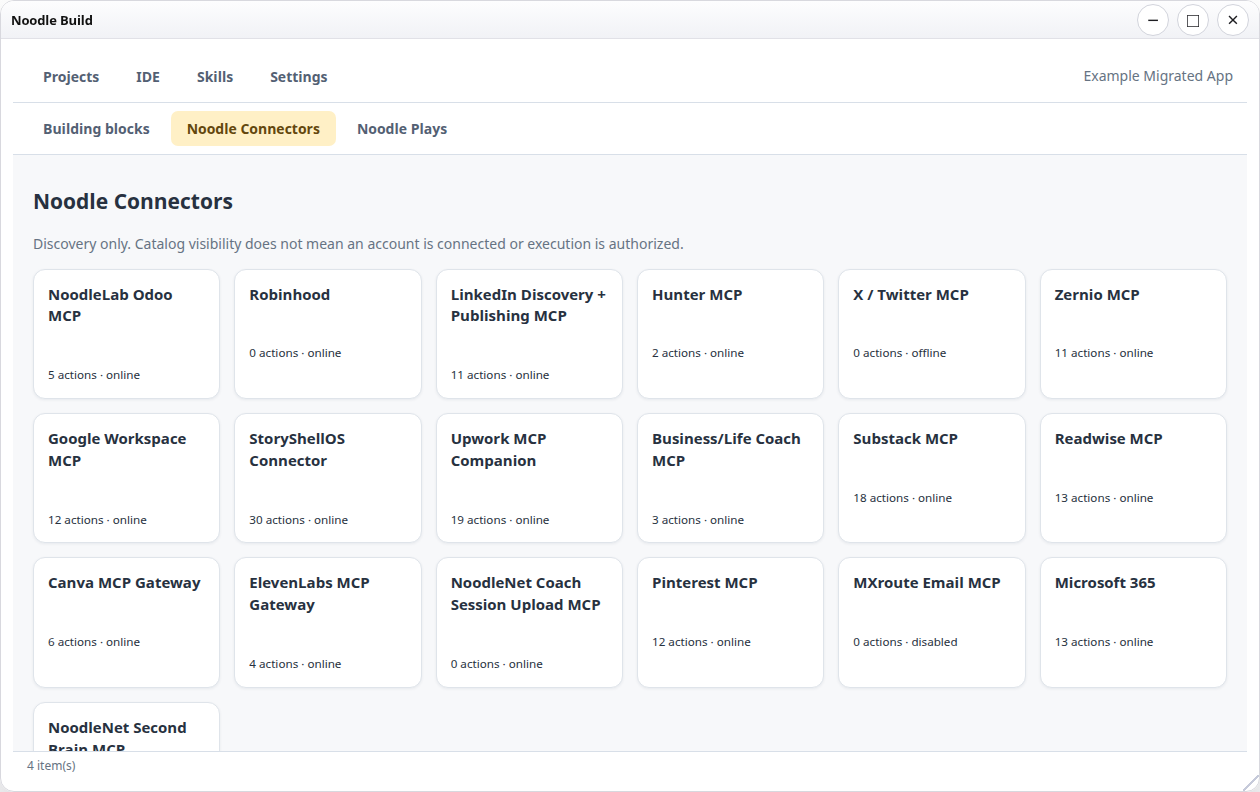
The catalog describes available connectors. It does not authorise account access or execute the listed actions. Controlled test session; fictional examples.
AI-generated editorial illustration—not product hardware or a screenshot.
Keep the test example beside the change review. Ask which files changed, whether the explanation matches the calculation and whether a correction changes an earlier result.
Seeing the source is helpful but not sufficient. A reviewer still needs to understand the rule and check its behavior. The example should include a failure case as well as an ordinary one.
Don't turn discovery into an integration claim
The documented connector panel browses action descriptions and input schemas from the existing connector service. It is metadata discovery, not account authorisation or action execution.
Finding an action that sounds relevant does not show that the intended Odoo version is supported, that a client account is connected or that the proposed operation has been tested. An input schema describes what an action expects; it does not prove the proposed values are appropriate.
Actual integration needs separate evidence for the account, access scope, affected records, expected behavior and result. A read should not quietly become a write because a generated workflow chose a convenient action.
Make the handoff honest
A useful prototype handoff says what the example demonstrates and what it does not. Keep the source, known inputs, expected results and unresolved integration questions together.
Eleven legacy source projects and their records have been migrated into the new workspace. This preserves source; it is not automatic native Flow or runtime conversion. An imported helper still needs compatibility and runtime review before running. Neither that migration nor an example result proves an Odoo integration or completed remote delivery.
Use the prototype to narrow the next question: which part of the real workflow is worth integrating, and what would count as evidence that it works?
The consultant-facing discussion of selling the human filter rather than another AI alert connects these technical boundaries with the responsibility a client is actually buying.
Have an Odoo workflow in mind, but want to understand the boundary before anything touches live records? Let's grab a coffee and talk through the options.