A small team does not need an enterprise project suite to begin organizing useful AI work. It needs a place where the work has a name, an owner, a next step, and enough context for a human or digital worker to understand what is happening.
That is the value of starting local with nnProjects, the project layer inside NoodleNet. Projects and tasks can hold notes, dates, links to related work, status, ownership, and a visible history. Standup views help surface what needs attention. The team can keep the working context close to its own knowledge and AI operating environment while it learns which processes are worth making repeatable.
That local starting point is deliberate. It lets a business get clear about its work before designing a large integration around it.
Local does not mean isolated
As a business grows, the coordination problem changes. Several departments may need portfolio views. Client teams may already be committed to a commercial project manager. Leadership may need reporting across hundreds of projects. Compliance or procurement may dictate which system holds the official record.
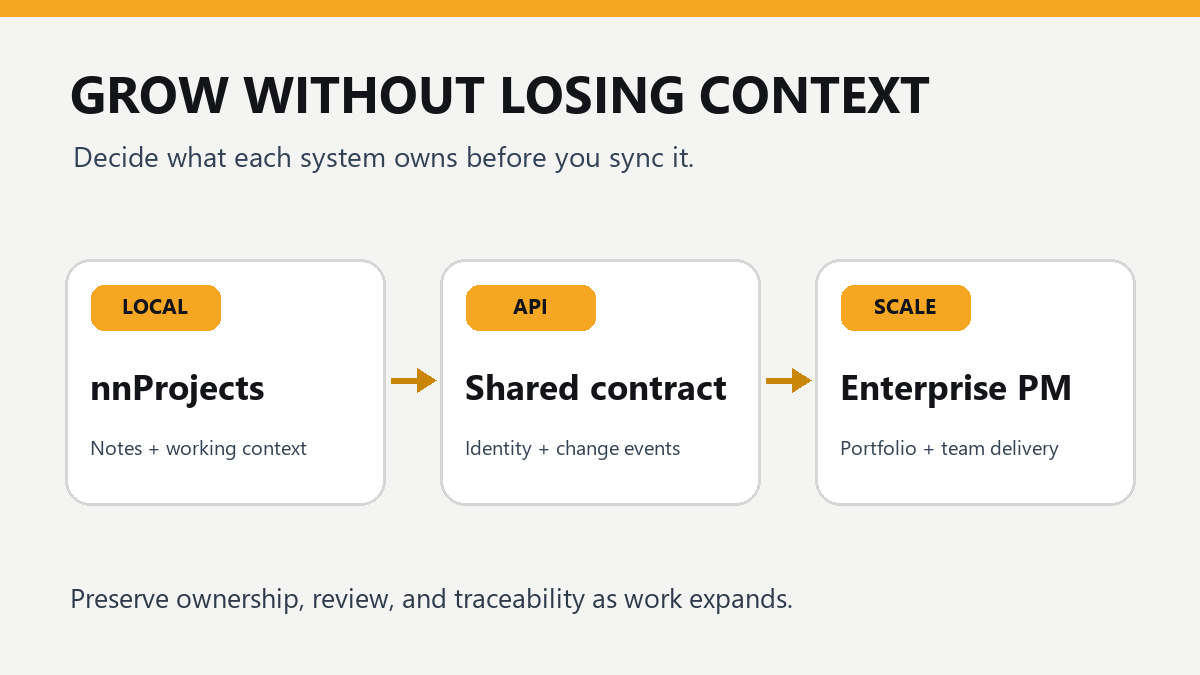
At that point, the answer may be to connect nnProjects with an enterprise project platform, or to move some project coordination into that platform. Either route should preserve the useful context and human controls built at the local level.
That is why an AI operating system, or AIOS, needs to be flexible about its project layer. Local-first should describe where you can begin and how you retain control. It should not trap your work inside one interface.
The project manager becomes a boundary between systems
An AIOS gives digital workers roles, skills, approved knowledge, procedures, and review rules. A project manager gives the work a shared state: this task is ready, this person owns the decision, this dependency is blocked, this result has been approved.
When the project manager changes, those meanings must travel with the work. An agent needs to know whether “done” means the draft exists or the human approved it. A standup needs to know which system has the current due date. A connector needs stable identifiers so it does not create the same task twice.
These are design questions. A strong API is what makes the answers implementable.
What to demand from an AI-forward API
For a larger project platform, I would test the real workflow rather than accept an “AI-ready” label. Can an authorized integration:
1. Read and update the project and task fields the team actually uses? 2. Preserve owners, dates, dependencies, custom fields, comments, and links to source material? 3. Receive reliable events when work changes, with a way to verify the sender? 4. Use scoped credentials and separate human approval from an agent's draft work? 5. Page through and export enough data to reconcile the two systems? 6. Handle rate limits, retries, and conflicts without silently losing or duplicating work?
The answers vary. For example, Wrike documents account and space webhooks, while monday.com documents daily API quotas by plan. Those are useful facts, but they only matter in the context of the workflow you plan to run. A high call limit does not help if a critical operation is missing. A rich event stream does not help if the team cannot afford the plan that exposes it.
Decide what owns each piece of truth
The safest transition begins with a simple map. Which system owns the task? Which owns the approved document? Which keeps the agent's working notes? Where does an approval become final? What happens if two people edit the same item before a sync runs?
You do not need every answer on day one. You do need to avoid letting two systems silently claim to be the authority for the same field.
One sensible pattern is to keep local knowledge, agent skills, and review procedure in NoodleNet while an enterprise project platform owns the official project and task record. Another team may keep nnProjects as the primary work layer and send only selected milestones or status updates outward. The right boundary depends on the business, its existing tools, and the stakes of a mistake.
The important point is that the boundary stays explicit and can evolve.
Build for the next stage without buying it today
nnProjects gives a team a practical place to begin: name the project, capture the context, assign work, see what is waiting, and review the result. If the organization later needs enterprise scale, an API-forward project manager can extend that operating model instead of forcing it to be rebuilt from scratch.
That is the choice to make early. Pick an AIOS that can start close to your people and your knowledge, then connect to larger systems when the work calls for it. Pick a project manager whose API supports the real handoffs your people and agents will need.
The goal is steady growth: local control, clear ownership, and enough openness for the tools to work together.
Explore NoodleNet Pro or start by examining one real handoff with the Creative Spark AI, Prompt and Workflow Audit.
Related reading: Your Project Manager Is an Integration Decision