Small businesses do not need AI work scattered across six chat tabs, three automation tools, a shared drive, and whatever someone saved in a note called "final-final-good-prompt."
That is not adoption.
That is a filing cabinet falling down the stairs.
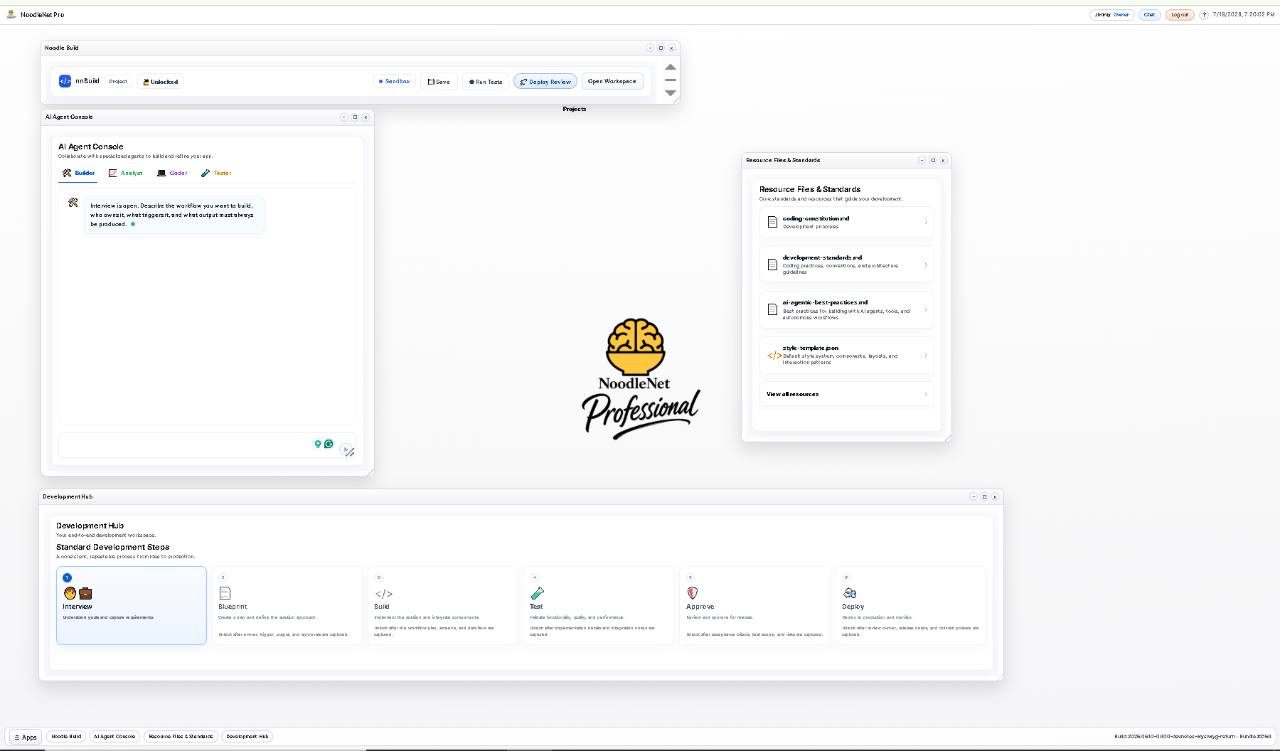
Noodle Build is part of the NoodleNet idea: give a business a practical place to design, organize, test, and grow its AI-supported work without losing control of the company in the process.
The app is currently in beta, which means the direction is real, the foundation is being tested, and the details are still being shaped around actual use instead of slide-deck fantasy.
It is a development environment, but not in the "congratulations, you accidentally joined a developer conference" sense.
It is meant to help a small company keep the important pieces together.
The work needs a home
Over the last few posts, I have been talking about the NoodleNet operating model:
- digital workers own responsibility;
- skills define what those workers can do;
- plays turn useful work into repeatable procedures;
- execution layers make real work reliable;
- connectors provide access to outside tools;
- knowledge, models, and memory provide context;
- approvals, logs, validation, and reporting keep people in control.
That is a good model.
But a model by itself does not help much if everything still lives in different places.
The business needs somewhere to manage the pieces.
That is where Noodle Build fits.
Build the system around your business
Most small companies do not start with perfect workflows.
They start with real work.
Customer requests.
Invoices.
Sales follow-ups.
Project handoffs.
Training documents.
Internal notes.
Policies that may or may not be current.
The useful question is not, "How do we make AI sound impressive?"
The useful question is, "How do we turn the work we already do into something clearer, safer, and easier to repeat?"
Noodle Build is designed for that question.
It gives the team a place to think through workflows, define the pieces, keep standards close to the work, and build toward something that can actually be maintained.
Local-first matters
Small businesses should not have to hand their whole operation to a mystery cloud pile just to get useful AI.
Some tools should stay close to the business.
Some knowledge should stay under the company's control.
Some workflows should be understandable by the people who actually run them.
NoodleNet is built around that local-first instinct.
That does not mean the system can never connect to anything else. It means the business is not forced to give up ownership of its working environment just because it wants better AI support.
There is a difference between connecting to useful services and becoming dependent on a locked box you cannot move away from later.
That difference matters.
Standards make the exit door visible
One of the quiet problems with small-business software is lock-in.
You start with one tool because it solves one problem.
Then the tool becomes the process.
Then the process becomes hard to move.
Then everyone is afraid to touch it because the business now depends on a pile of settings nobody remembers making.
Very modern. Very expensive. Very annoying.
Noodle Build is designed to keep standards close to the work: documentation, resource files, development steps, testing, approvals, and deploy paths that do not depend on one person's memory.
The goal is not to trap a company inside NoodleNet.
The goal is to help the company build in a way that can grow, adapt, and move if the business needs to move later.
That is what standards are for.
Not paperwork theater.
Portability.
Clarity.
Less panic when the future changes its mind.
Start small, grow on purpose
A small business may begin with NoodleNet BASIC: approved knowledge, reusable prompts, playbooks, and practical Q&A.
Then the business may identify a workflow worth improving.
Then it may need a worker, a skill, a play, a connector, or an approval process.
Then it may need a department-level NoodleNet Pro environment.
The system should not force the company to leap from "we have a few useful prompts" to "please enjoy this enterprise platform with 9,000 buttons."
Growth should be staged.
Useful first.
Expandable second.
Manageable the whole time.
That is the point of Noodle Build.
The business should still understand the system
AI systems get dangerous when they become magical.
Not dangerous in the movie sense.
Dangerous in the "nobody knows why this customer email went out wrong" sense.
A business should understand:
- what is being built;
- which knowledge is approved;
- what a worker is allowed to do;
- which skills are available;
- when a play runs;
- what requires approval;
- where the logs live;
- how the system can be changed later.
That is not extra.
That is the difference between using AI and being dragged around by it.
Why this matters for small companies
Big companies can throw departments at complexity.
Small companies cannot.
Small companies need systems that are practical enough to use, clear enough to explain, and flexible enough to grow without requiring a complete rebuild every time the business changes.
Noodle Build is meant to support that path.
It keeps the operating model, standards, development process, and business context closer together.
It helps the company build AI-supported workflows without turning the whole operation into a pile of disconnected experiments.
And it does that while respecting a simple idea:
Your business should still belong to you.
That should not be a radical position.
But here we are.