
The demo ends when the application produces an answer. The business process ends when the right outcome is accepted, recorded and supportable tomorrow.
That gap is where many promising AI projects become expensive experiments. Somebody must install the application, connect its systems, maintain access, investigate failures and decide whether it is still useful. Construction is one phase of the work, not the whole product.
Eight verbs that make the operating model concrete
Build: define the outcome, interface, data, reusable skills and acceptance rules. A skill explains how work should be performed; a tool supplies a capability. Neither is a substitute for permission to use the capability.
Deploy: produce a known package, identify its runtime requirements and keep environment-specific secrets outside the distributable artifact. Record the version and the rollback path.
Connect: choose authoritative systems and grant only the operations the workflow needs. A connector being installed does not prove that a particular account or organization is authorized.
Run: distinguish deterministic steps from AI-generated recommendations. Specify timeout, retry and duplicate-prevention behavior before unattended execution.
Monitor: record starts, completions, failures and unresolved states. Include source identity and correlation IDs so an operator can follow one piece of work across components.
Govern: enforce access and approval boundaries in the actual execution path. A sentence in a prompt is not proof that a destructive action is blocked.
Measure: compare accepted outcomes with a baseline. Keep model usage, service health and business value separate.
Improve: change one identified weakness, test the exceptional cases and compare results. Do not let automatic retries conceal a process that keeps failing.
What an appliance does—and does not—promise
An application appliance packages a focused working environment for a business purpose. The user should not have to assemble every underlying component to perform that purpose. The operator still needs an inventory, recovery method, update procedure and clear support boundary.
Containers can help make packaging repeatable. They do not automatically prove portability across operating systems, processor architectures or customer environments. A successful Linux deployment is evidence for that deployment, not a Windows or Raspberry Pi certification.
NoodleNet's research brief describes a Rapid Deployment Environment and several target patterns. Those descriptions are product direction unless supported by a tested release and target-specific evidence. This series does not claim a generally available one-click RDE or verified Linux/Windows/Raspberry Pi support matrix.
The current Pro Build service responds and exposes package metadata. Its operating standards distinguish validation, staged installation testing and export. A real rollout should still demonstrate those operations for the exact application, dependencies and destination being sold.
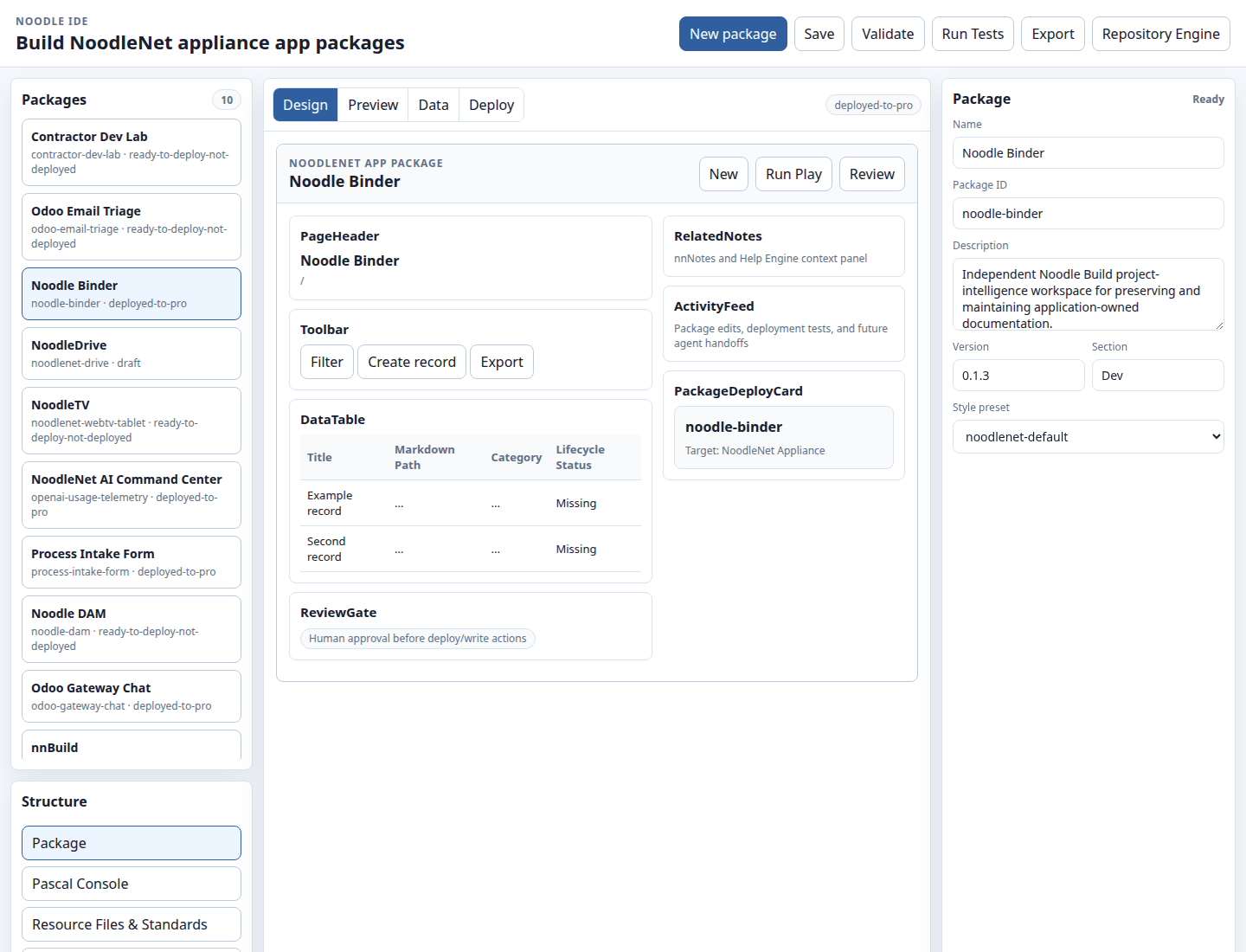
Product image: NoodleNet Pro Build, captured October 27, 2026. The selected Noodle Binder package is marked deployed-to-pro; the design canvas contains illustrative placeholder records, not live customer data. A visible review-gate label is not evidence that every integration enforces that gate.
Observability is necessary, but it is not the outcome
NoodleNet's current Pro event surface exposes execution events with timestamps, source identity and status. Its Observatory contract distinguishes operational events from AI usage and evidence-backed business outcomes. That is the right distinction to preserve in a customer deployment.
A completed model request is not a completed onboarding. An event count is not revenue. A token count is not an invoice unless the pricing basis is known. Missing cost data should remain unknown rather than becoming a reassuring zero.
For onboarding, measure accepted accounts, exceptions requiring intervention, duplicate operations, time to acceptance and rework. A baseline should specify the sample, start/end definition and who verified the result. If you have no baseline, begin collecting one; do not manufacture a percentage improvement for the launch slide.
An adoption scorecard for a small business
Score each category from 0 to 2: 0 means unknown or absent; 1 means documented but not demonstrated; 2 means demonstrated with evidence for this workflow.
- Outcome: acceptance is defined and an accountable owner is named.
- Data: authoritative records and permitted context are mapped.
- Access: connector scopes and denied operations are tested.
- Reliability: missing inputs, timeouts and duplicate prevention are tested.
- Oversight: the real approval and escalation path is demonstrated.
- Operations: a named operator can monitor, update and recover the system.
- Measurement: a baseline and accepted-outcome metric exist.
- Exit: the business can export its records and recover its working knowledge.
The maximum is 16. This is a planning rubric, not a validated readiness certification. More important than the total is the pattern: a zero in access, recovery or oversight can be a reason to stop a consequential rollout even if the rest scores well. Fix the weakness instead of averaging it away.
For a low-risk pilot, restrict the first release to recommendations or drafts. Expand authority only after the evidence supports it. A human approving ten drafts manually can teach more about the failure modes than an unattended run through a hundred uncertain actions.
Why consultants and MSPs matter after the build
A consultant can translate a business exception into a workable rule. A managed service provider can own deployment health, access changes, backups, monitoring and updates. A vertical specialist can maintain the domain-specific procedure that makes a workflow useful.
That ongoing work is valuable when it has a defined service boundary. Who responds when a connector token expires? Who checks an upstream API change? Who tests recovery? Who reviews a model change against the same acceptance examples?
The commercial offer should name those responsibilities and the evidence the customer receives. “Managed AI” without a named operating commitment is too vague to evaluate.
Make the next demonstration an operating demonstration
Ask to see one successful run, one denied action, one recoverable failure and one restored record. Ask where the business can find the source, the approval, the deployed version and the accepted outcome.
The Visual Basic analogy is strongest when it reminds us to make useful construction accessible. It becomes misleading when it implies that modern AI systems are as predictable as a button event or that packaging removes operational responsibility.
NoodleNet's ambition is Interconnected Intelligence for Business: people, applications and agents working with shared context and clear boundaries. The proof is the operating loop.
Next step: score one candidate workflow, circle its weakest category, and start a practical NoodleNet conversation about that gap. You do not need to automate the entire business to make one handoff better.