The AI-powered business is arriving one decision at a time.
A new subscription here. A useful prompt there. A Copilot rollout. A custom agent. A workflow connected to a CRM. A local model used for sensitive work. An AI feature quietly enabled inside software the company already owns.
Before long, the business has something that looks a lot like an AI operation.
The problem is that most businesses do not yet have a way to manage it as one.
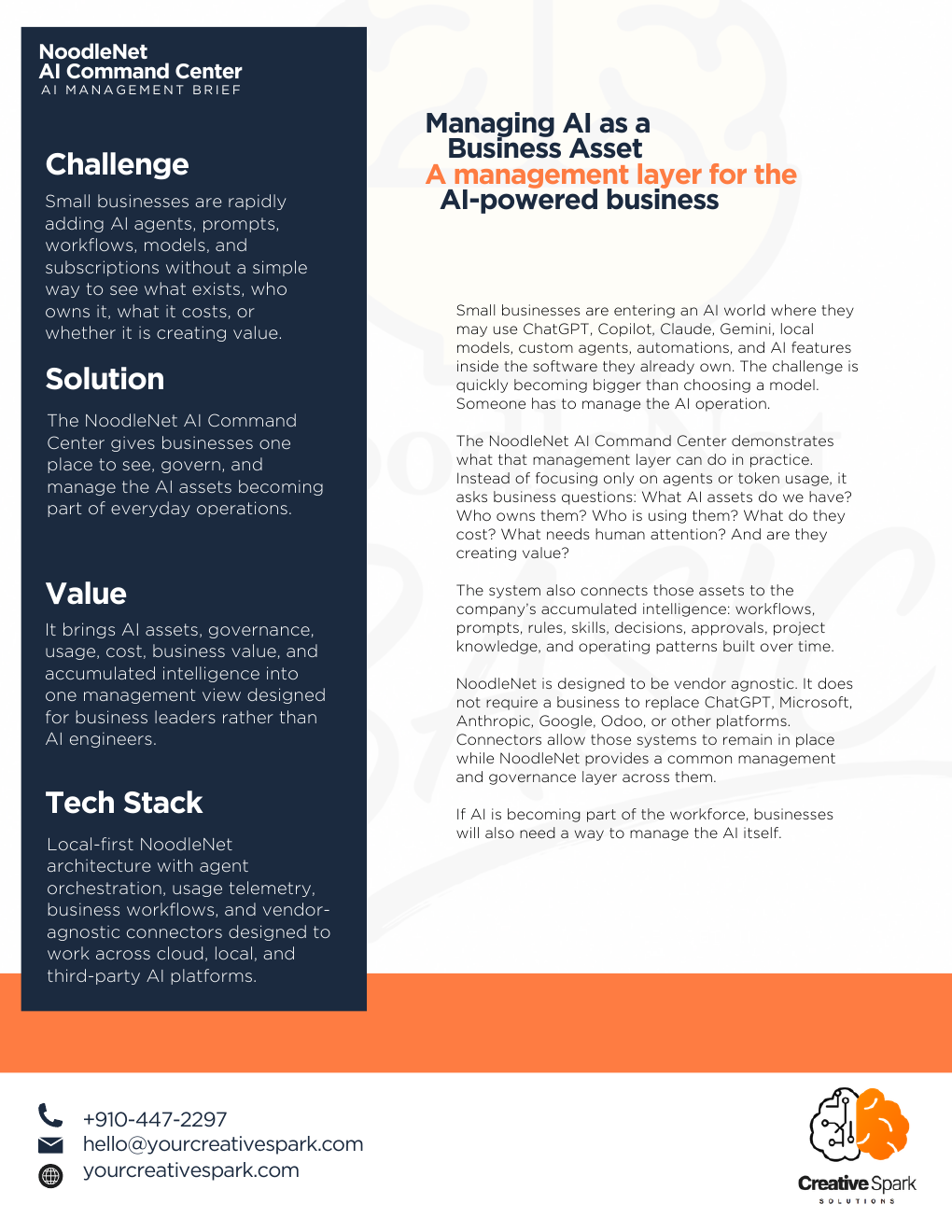
That is the idea behind the NoodleNet AI Command Center: a management layer for the AI assets becoming part of everyday work.
The next AI problem is operational
Choosing a model is only one decision.
Once AI starts participating in real work, leaders need answers to a broader set of questions:
- What AI assets do we have?
- Who owns them?
- Who is using them?
- What do they cost?
- What needs human attention?
- Which systems and knowledge sources can they access?
- Are they creating value?
Those are not model-benchmark questions. They are operating questions.
The organization needs one place where the answers can be seen together.
AI assets are more than agents
An agent may be the most visible part of the system, but it is only one asset type.
The full operating picture can include:
- models and providers;
- agents and digital workers;
- prompts and reusable skills;
- plays and automations;
- connectors and external tools;
- approved knowledge sources;
- subscriptions and usage plans;
- human review and approval rules;
- logs, corrections, and operating history.
When these pieces live in separate dashboards, chat histories, folders, and employee accounts, leaders cannot see the real system.
The Command Center approach brings them into one management view.
Visibility should lead to action
A useful management layer does not only count assets.
It helps distinguish between what is active, what is approved, what needs attention, and what should be retired.
Employees need a simple way to discover approved AI assets, understand what they do, access the right agents and workflows, and get contextual guidance.
Managers need a different view. They need to track ownership, prompt changes, usage, cost, governance, business value, and where human judgment is still required.
The same system should support both experiences without forcing every employee to become an AI engineer.
Usage telemetry needs business context
AI usage can be measured in requests, tokens, model calls, and dollars.
Those measures matter, but they are incomplete on their own.
The stronger question is what happened because of the usage.
Did the agent complete a repeatable task? Did a person approve the result? Did the workflow reduce turnaround time? Did it create a useful business record? Did the process fail and require intervention?
Telemetry becomes valuable when it can be read beside ownership, workflow state, human review, and business outcome.
That is how a cost number becomes an operating signal.
Accumulated intelligence belongs in the system
Every organization develops intelligence as it works.
People refine prompts. They document procedures. They create reusable skills. They make decisions, approve exceptions, correct mistakes, and learn which patterns work.
That accumulated intelligence is one of the most valuable parts of an AI operation.
NoodleNet treats it as an asset that should remain visible and reusable across projects, workers, and workflows. It should not disappear when a chat closes or remain trapped in one employee's private account.
The goal is a system that learns how the business operates without surrendering control of that knowledge to a single vendor.
Vendor agnostic by design
Small businesses will use more than one AI platform.
They may rely on ChatGPT, Microsoft Copilot, Claude, Gemini, local models, industry applications, and AI features inside the software they already own.
NoodleNet is designed around that reality.
Connectors allow those systems to remain in place while NoodleNet provides a common layer for inventory, governance, workflow, memory, and oversight.
This is not about replacing every tool.
It is about managing the operation that now spans them.
Simple, usable, transparent
The management goal can be summarized in three words.
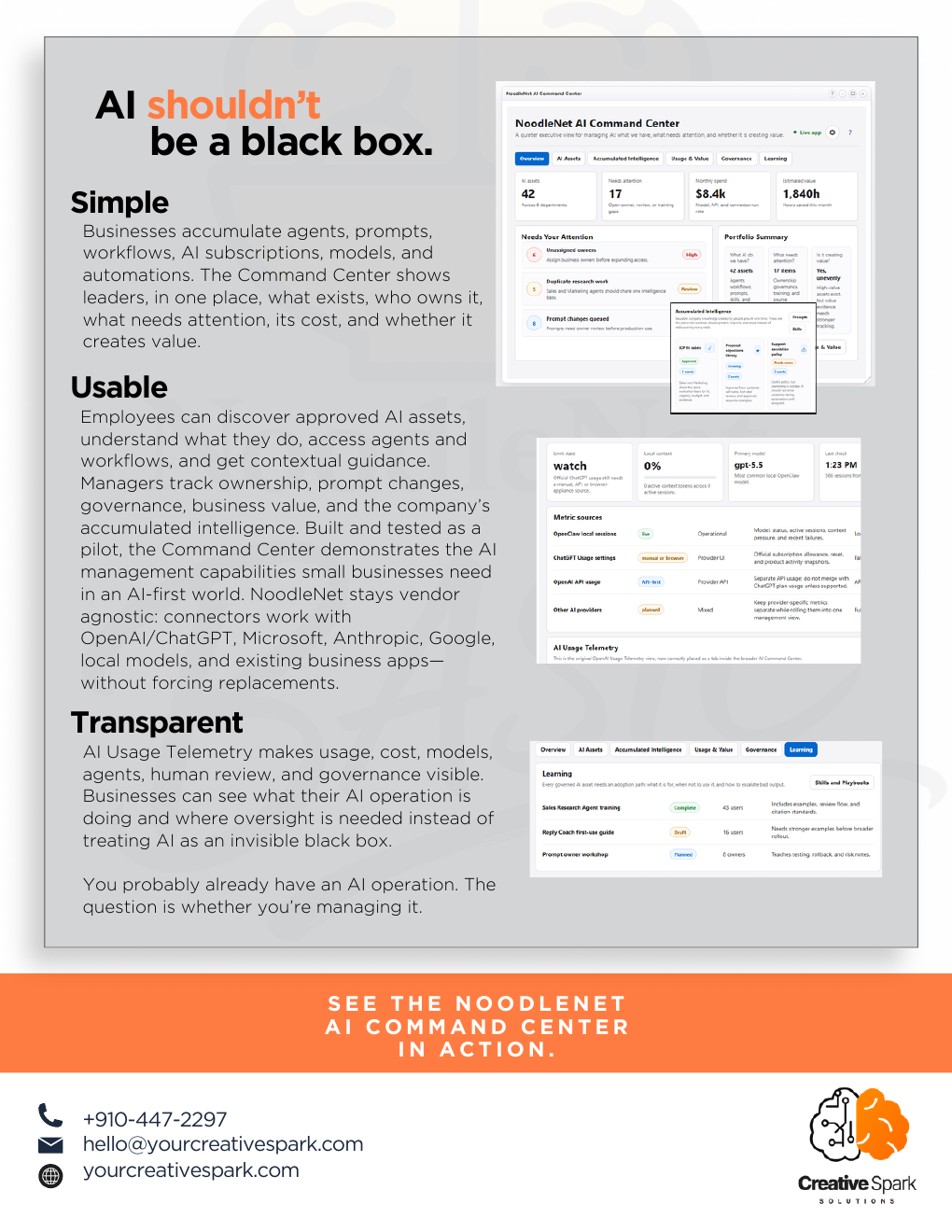
Simple
Leaders should be able to see what exists, who owns it, what it costs, what needs attention, and whether it creates value.
Usable
Employees should be able to find approved AI capabilities and understand how to use them. Managers should be able to govern changes, approvals, and value without living inside technical logs.
Transparent
Usage, cost, models, agents, human review, and governance should be visible. AI should not operate as an invisible black box inside the company.
The management layer comes next
If AI is becoming part of the workforce, the business will need a way to manage the AI itself.
That means moving beyond isolated tools and toward an operating view: assets, owners, workflows, knowledge, cost, controls, and business value connected in one place.
You probably already have an AI operation.
The question is whether you are managing it.
Download the two-page NoodleNet AI Command Center management brief.