AI can help write an application. It can also help inspect one. Neither activity should quietly hand it permission to change the business.
A small integration can sit between customer records, project work, invoices, and the people trying to keep everything moving. A review that spots a possible permission problem is useful. A process that checks the finding, explains the consequence, and puts the decision with the right person is more useful.
That is the NoodleNet angle on AI-assisted code review: connect the intelligence to the work, without confusing a recommendation with authority.
A real review, with a useful boundary
The NoodleNet Pro Noodle IDE screenshot below shows an advisory source review of an Odoo Gateway Chat application. The report says the source was not changed. No automatic fixes or deployment occurred.
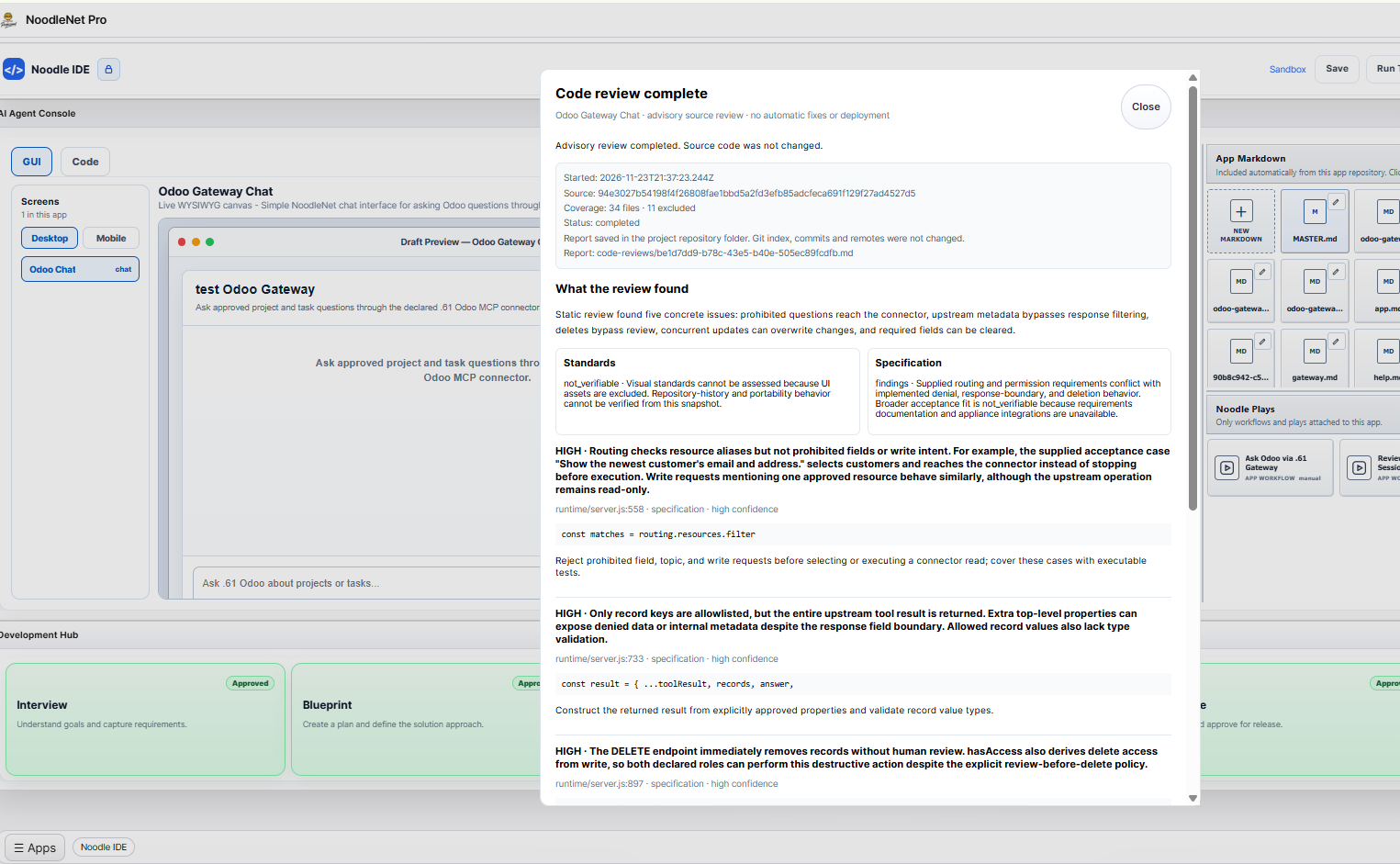
One completed source review. The reported findings still need investigation; this image does not demonstrate continuous monitoring, reproduced vulnerabilities, or completed repairs. Open it to read the report.
The report records 34 included files and 11 exclusions. It identifies five candidate concerns: requests reaching a connector outside its intended purpose, extra information getting past the response filter, deletion without the required review, overlapping updates overwriting work, and required values being cleared.
Those observations matter because they connect to recognizable business questions:
- Can an assistant see information this person should not see?
- Can a routine update erase something the business needs?
- Who decides whether a record may be deleted?
- What happens when two people change the same item?
- What was actually checked, and what remains unknown?
The report is a starting point for answering those questions, not proof that every suspected problem exists. It also names areas it could not verify. That honesty is part of a useful review.
The code is only one piece of the business system
A chat application may appear to be a text box and an answer. Behind it are permissions, data sources, connectors, business rules, and someone responsible for the outcome.
Imagine an assistant meant to answer questions about approved project tasks. A user asks it to retrieve unrelated customer information. Even a read-only connector can expose the wrong information if its purpose and access boundaries are not enforced.
Or imagine an approved task update that accidentally clears a required field. The request sounds harmless, but its effect may be a broken handoff or incomplete customer record.
These are illustrative scenarios, not claims of customer incidents. They show why reviewing the code without understanding the workflow can miss the point. The question is not only “does this function run?” It is “does this operation belong in this person's workflow, with this information, under these conditions?”
Odoo's security documentation separates model access, record rules, and field access. An AI-facing application needs to respect those underlying permissions as well as its own narrower purpose. A prompt that says “be careful” is not a substitute for enforced access rules.
Connected Intelligence needs a decision path
NoodleNet's operating-model approach brings knowledge, tools, workers, and human oversight together. Code review makes the reason for that combination concrete.
The review needs context: what the application is supposed to do, which information it may use, and which business rules matter. The person reviewing a finding needs evidence and a clear next action. The person authorizing a change needs to know what will be tested and how the team can recover if it fails.
That is Connected Intelligence in practical terms: the observation does not stop in an isolated chat. It belongs alongside the work it concerns and the people who own the decision.
This is an operating pattern to build deliberately. The screenshot demonstrates the advisory review, not an automatic end-to-end repair and release system.
Give the findings a funnel
More warnings do not automatically mean more control. A useful workflow should reduce noise and make consequential decisions clearer.
- 1. Set the boundary. Record the application, source version, review purpose, included files, exclusions, and relevant business rules. Be explicit about what the review cannot establish.
- 2. Collect possible problems. Use AI observations alongside existing tests and scanning tools. Keep the evidence with each finding rather than treating the wording of the report as proof.
- 3. Check the consequence. Reproduce the relevant behavior where possible. Reject false alarms and duplicates. Explain confirmed issues in business terms: exposed information, lost values, conflicting updates, or missing authorization.
- 4. Ask for a human decision. Give a named reviewer the proposed change, affected workflow, tests, and recovery plan. Approval, rejection, and accepted exceptions should remain distinguishable.
- 5. Test and verify the authorized change. Test away from the live system. Release only the agreed version, then check what actually happened. A saved fix, a passing test, and a verified release are different results.
A human approval step is not enough by itself. The application must still refuse disallowed actions. OWASP's excessive-agency guidance explains why tool permissions and authorization must be constrained outside the language model, with human approval for high-impact operations.
Local-first does not mean risk-free
A local-first workspace can give a business a home for its knowledge on equipment it controls, with deliberate choices about connected services. It does not make every connector safe, every model correct, or every operation private by default.
Choose what source material a review may use and where that material is processed. Keep sensitive information out of unnecessary requests. Limit access to what the task needs. Preserve approval boundaries even when the model is running locally.
Source review also does not replace backups, dependency scanning, endpoint protection, runtime monitoring, or specialist security testing. It is one useful check within a larger operating discipline.
Start with one workflow worth protecting
For a business owner, the starting point is an integration or application whose failure would interrupt real work. For an Odoo consultant or MSP, it may be a client customization that needs a clearer review and change process.
Start small: one application, one agreed source version, a bounded review, and a short decision packet. State what was checked, which findings were confirmed, what remains uncertain, who owns each action, and what may happen next.
If recurring reviews prove useful, agree on the triggers, scope, ownership, and release authority. Do not mistake an occasional report for continuous coverage.
Managing AI as a business asset means keeping ownership and oversight visible. Building beyond the AI demo means carrying that discipline through testing, release, and ongoing use.
AI can help find the signal. People still own the decision—and the system needs to enforce that boundary.
Have an integration, customization, or repeated support problem in mind? Talk with us about NoodleNet. Bring one real workflow. We can explore where AI-assisted review could help and where your team's judgment must stay in control.